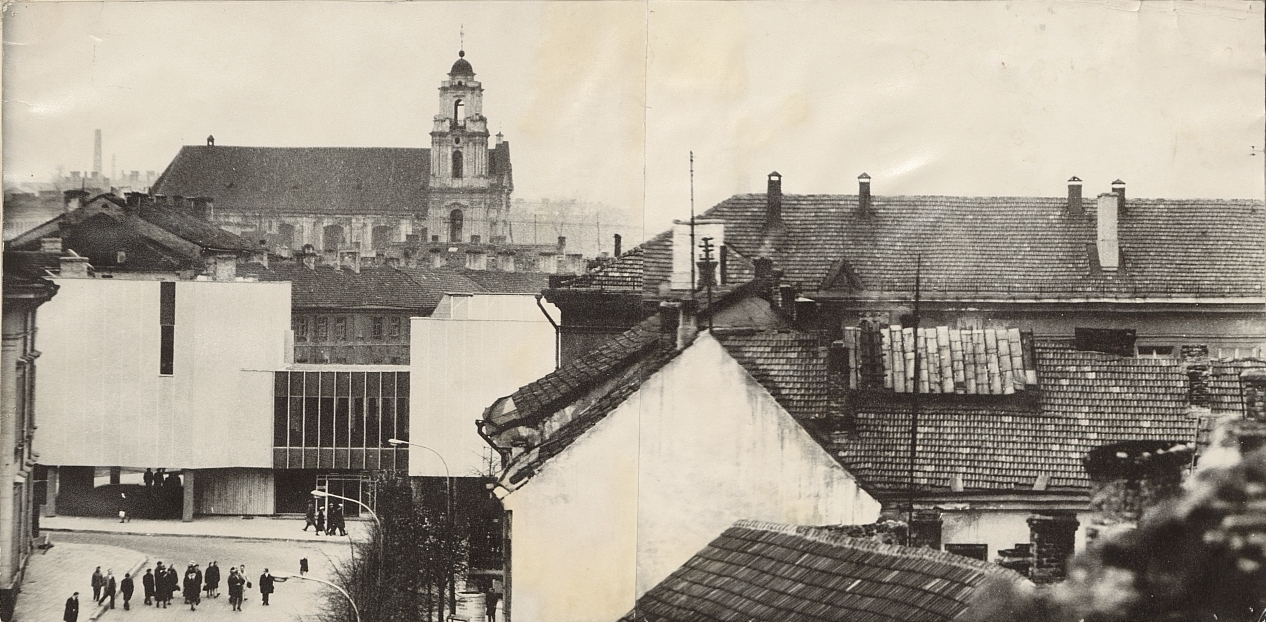
www.archmuziejus.lt (V. E. Čekanauskas collection)
Introduction
Protection of urban heritage is a comparatively new process not only in Lithuania, but the rest of the world. Individual buildings used to be valued, protected and regarded as “heritage” already back in the days of antiquity, while the urban tissue and cities in Europe have undergone a number of transformations already back in the mid and late 20th century by eliminating the ruins of war and later following the principles of modernisation.
The focus on the less obvious value of cities, towns and villages, hidden in their structure and often undistinguished “grey” buildings, began in the first half of the 20th century when the practice of protecting individual monuments and even discussions between advocates of different restoration paradigms, had already gained momentum in the rest of the world. Discussions about protecting urban heritage continued throughout the entire century until, the early 21st century and changing general understanding of heritage witnessed the development of a Historic Urban Landscape (HUL), which invites to take a holistic look at the historical urban heritage and stop trying to put everything “under a glass cover” in a museum.
The changes in urban heritage protection tendencies could be noticeable in Lithuania as well, although acquiring specific forms, related to the socio-political situation. Thus, the purpose of this publication is to provide a brief overview of the tendencies of changes in Lithuanian urban heritage protection, from the emergence of protection systems in the Interwar period to this day, discussing not only projects, but also researches and publications, which reveal the change of the concept of urban heritage and its protection.
Interwar period
The protection of urban heritage in contemporary Lithuania is related to the Interwar period. In those days Vilnius region applied a very advanced and complex (for that time) model of Polish heritage protection — buildings, “together with their natural environment, as well as elements and architecture-related artwork, developed during later periods” were regarded as heritage (Fedorovič 2012: 88). It should be noted that this approach was unique — after all, the focus on protecting the visual integrity of cities and complexes, as well as the importance of the environment (context) for understanding the monuments, was introduced only in the Athens Charter of 1931 [1].
Based on the almost unchanged structure of streets and quarters, in 1936 Vilnius Old Town was acknowledged as a relic (Kurienė, 2015), valued as an entirety i.e. determining regulations on works not only in individual monuments, but the entire central part of the old town, which meant that private house renovation, their façade colours and design of advertising signs could be made only according to special methods determined by the conservator (Fedorovič, 2015:91). The plan of “The Great Vilnius” was prepared in 1939. This document included ideas like reducing the population density in the old town, moving some of the trade out, building bypasses (Markevičienė, 1998:156), refusing any ideas of building any new buildings and only revealing the old valuable monuments by demolishing the “ugly” 19th century buildings (Kučiauskas 2015:226). Practical heritage protection issues included heritage analysis and several publications on important issues of heritage protection (M. Morelowski, S. Lorentz , J. Remer et al.) (Fedorovič 2012: 86).
Compared to Poland of that time, the issue of heritage protection, as well as protecting urban heritage in Interwar Lithuania was not as important. This can be illustrated by the fact that no individual law on protecting monuments was adopted in twenty years. The state took care only for some individual and the most significant buildings or those that were already falling apart (conservation of the gothic church of Zapyškis, renovations of Kaunas, Panemunė and Raudonė castles). Moreover, the heritage was strictly divided into the national and foreign (with manor settlements as the best example) (Čepaitienė 2005:83-91). Thus it becomes obvious that cities and towns inhabited by non-ethnic Lithuanians could have been regarded as objects requiring of “re-Lithuanisation” than cultural heritage that should be protected.
Nevertheless, after the Republic of Lithuania recovered Vilnius, the tendency of general protection was continued. Discussions regarding the image of the capital featured opinions in favour of preserving the old street structure and restricting “modern” constructions in the old town, directing them towards the outskirts of the city (Markevičienė, 1998: 147).
The years of war and after war
The principles of the understanding of the old town protection cardinally changed already in 1941. Twisting and turning narrow streets of the old town, as well as a large number of protected ancient monuments stood in a way of building a socialist city. Criticism fell on the concept of conservation, leaving the old town residents in medieval poverty and darkness (Markevičienė 1998: 157-158), therefore, it was suggested to make capital reconstructions of this part of the city (Markevičienė 2003: 252), but due to the German occupation these ideas were never implemented.
After the war the architect Zigmantas Čaikovskis lead the preparation of the Damage Plan, which said that the number of destroyed houses was only 11, almost destroyed — only 45 with 125 houses in need of capital renovations, while the remaining 344 were intact or required only minor renovations (Drėmaitė 2010:184). Nevertheless, the modernistic concept of “The Capital of the Lithuanian SSR” was still to be implemented (Drėmaitė 2010:192) thus promoting on the image of the “city of ruins” that can be planned anew (with the current Vokiečių street as the best example). On the other hand, the general provisions were already more reasonable — in 1947 Vilnius was officially included into the list of 20 historical cities of the USSR (Drėmaitė, Petrulis, Tutlytė 2012:68) and there were suggestions to “combine architecture and history with the principles of socialistic planning” (Markevičienė 2003:253), i.e. modernise the old town by bringing it closer to the standards of a socialistic city (Kumpis 1945). On the other hand, we could not say that demolitions were promoted by only pro-soviet persons — the already-mentioned M. Morelowski also suggested to demolish damaged buildings “for urban improvement and restoration of the beauty of the old Vilnius” (Kučiauskas 2015:231).
Another important turning-point happened several years later. When the last Polish specialists lost their jobs or emigrated, the connections with the Polish urban heritage protection tradition were completely lost. In the 1950s the young heritage protection specialists, originating mostly from rural areas, had to create the heritage protection system anew.
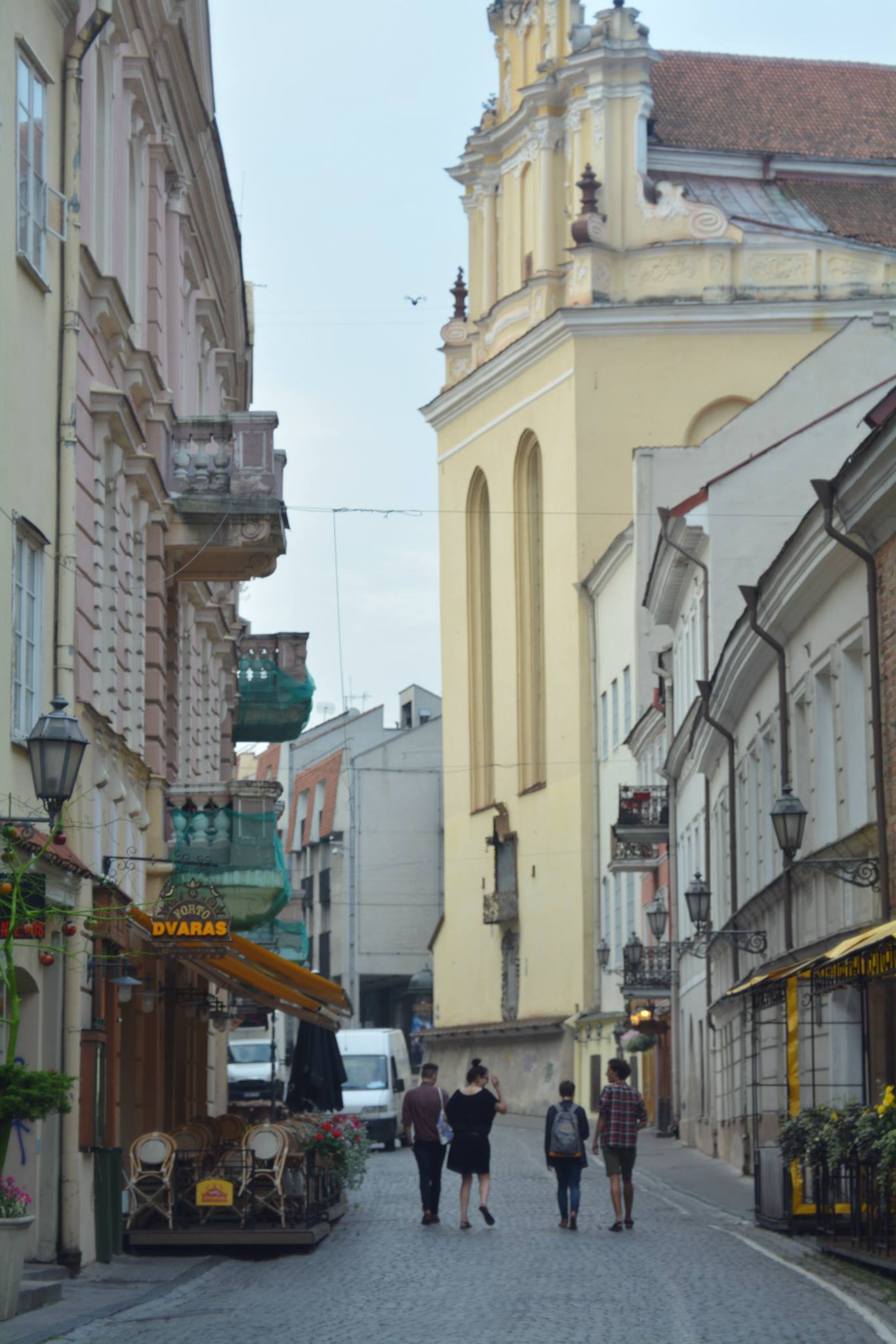
M. Šiupšinsko photo
Protection of historical old towns in the Soviet era
The General Plan of Vilnius of 1953, which was based on the “Soviet methods and experience of urban construction” (Mikučianis 2001:57, 65) and ignored the solutions of the Damage Plan (Miciūtė, Glemža 2015:274), provided wide thoroughfares crossing the old town (“According to the plan, a number of 11-15 metre-wide streets were supposed to be widened to 30-35 metres by demolishing low-value buildings”) (Jurginis, Mikučianis 1956:161). The reconstruction of Vokiečių street took place at the same time. These tendencies received sharp criticism from the architect community and, finally, in 1956 it was decided to prepare a special document for old town planning — the project for reconstruction of Vilnius Old Town — which was the first in Lithuania and the entire Soviet Union. Interestingly, this project had two versions (one, the Scientific Restorative Workshop, focused on protection and the other, containing suggestions of Lietprojektas, based on rather radical principles of modernisation) (Januškauskaitė 2013:138-154). Nevertheless, the restorers’ project was approved in 1959 (led by prof. K. Šešelgis, S. Lasavickas, J. Šeibokas), which became a precedent of other analogous projects in Lithuania (reconstruction project for the old town of Kaunas, approved in 1961 (S. Čerškutė, V. Jurkštas, K. Šešelgis), for Klaipėda — in 1963 (S. Čerškutė, V. Jurkštas, V. Parčiauskas), for Kėdainiai — in 1963 (S. Čerškutė, V. Jurkštas) and other states of the Soviet Union.
Contemporary opinions about this project are controversial and often biased. The majority of heritage protection specialists and architects emphasize that it was innovative and prevented the destruction of the old town (for example, Miškinis 1990:82, 129); Glemža 2002: 30–31, 156; Miciūtė, Glemža 2015: 277–278), but fail to mention the fact that the solutions of creating a socialistic city remained unimplemented, thus romanticizing the project and claiming that there were no plans of sanation at all [2]. Another rather amateurish and radical attitude that has recently started spreading among the public (Verkelis 2015:67-73) creates the opposite opinion — the architects were inexperienced (although K. Šešelgis was regarded as the most prominent figure in the field in Lithuania) and blindly followed the authorities of that time, intending to destroy the old town. Looking for an objective assessment, it should be remembered that this project, just like the alternative version, belongs to the era, where sanation (reducing building density in order to improve ventilation and insulation of other premises) was as natural as renovation of monuments. It could be said that the authors of the Scientific Restorative Workshop managed to harmonise two contradictory requirements of the project task — to preserve the city of the past in a modern city — according to the understanding and possibilities of those days.
After about a decade Lithuania started talking about the necessity to update the decade-old reconstruction plans. Thus the regeneration projects for the old towns of Vilnius (A. Pilypaitis, E. Pilypaitienė, V. Jurkštas, etc.), Kaunas (A. Jakučiūnas, V. Jurkštas, etc.), Klaipėda (Ž. Mačionienė, S. Prikockis, N. Zubovienė, V. Zubovas) and Trakai (R. Jurgilas, A. Pilypaitis) were prepared. These documents also contained an ambiguous attitude to historical cities, focusing not only on their historical value, but also their non-compliance with contemporary needs. Although some publications do show some tendency of doing that (Verkelis, 2015), this should not be blamed solely on the occupants’ aspirations to destroy Lithuanian heritage. These tendencies can be noticed in many of the European post-war cities, which embraced the modern dreams of Le Corbusier — wide streets for fast transportation and enough sunlight for a modern man. Eliminating the consequences of war often resulted in even greater destruction of the old centres, referred to the Italian architect and heritage protection specialist Francesco Siravo, as “losses for progress” (Siravo 2009:19). Lithuanian old towns were no exception, although the official opinion declared a complex approach: protecting not only monuments, but also urban and architectural peculiarities, the character of the built-up area, the environment of valuable buildings (Resolution of the CM LSSR of 22 August 1969). The interpretation of interpreting these principles is an issue worth of a separate discussion.
Theoretical provisions
During the preparation of the first project of Vilnius Old Town reconstruction Lithuania had not yet developed its own restorers’ guild with its own professional provisions. There was no specific methodology in the entire USSR, although there were some fragmented reports in the press on results of urban reconstruction, achieved in “friendly countries”, such as Czechoslovakia (The Protocol of the Academic Council… 1958: 114-115). It could be said that namely Czechoslovakia of that time, being an example of heritage protection, was the mediator bringing international ideas to Lithuania, because the “second generation” projects were based on the opinion that the “historical environment assessment methods of the Czech specialists is the most complex and has the most substantial theoretical foundation” (Jurkštas 1994:26). Based on these methods, in the 1970s the architect V. Jurkštas created the old town building assessment methodology, yet today the results based on that methodology would be shocking, stating that “valuable” buildings, i.e. architectural monuments, constituted only 10.3 % of Vilnius, 6.8 % of Kaunas and 0.6 % of Klaipėda’s old towns (Jurkštas 1994:24). Moreover, 40% of the old town buildings in Klaipėda were categorised as “dull and worthless” (Prikockis, Zubovienė, Zubovas xxxx: 25-26), thus giving reason to demolish them based on the principle to save the character of the environment, yet improving individual buildings.
After the Soviet Union joined the ICOMOS organisation (the architect Jonas Rimantas Glemža was particularly active there), in 1973 Vilnius hosted an ICOMOS conference, dedicated for “The issues of protecting of historical city centres and adapting them to new demands of socialist countries” (Hinsch, 1980), attended by representatives of ICOMOS national committees of other socialist countries (USSR, Czechoslovakia, Bulgaria, Hungary, Poland and the GDR) (Activity of the National ICOMOS Committees… 1976:176), while the presentations praised the opportunities provided by the socialist system. Discussions on the topic of urban heritage protection took place on the national level as well, for example, at the scientific conference “Analysis and restoration of historical and cultural monuments in the Lithuanian SSR in 1976-1980”, which took place in 1980 and included the issue of revitalising old towns (Kaminskas, 1980). These issues were also analysed in the periodical publication Architectural Monuments [3], as well as the series Urban Monuments of the Lithuanian SSR, published by the Scientific Research Institute of the Lithuanian Civil Engineering and Architecture in 1978-1988.
There was a complex understanding of the environment on the theoretical level, yet most often complexity was regarded as including the engineering and social factors (“of the city environment improvement issues”) into the planning (Jurkštas, 1994:12). We cannot forget the necessity to adapt to the system, therefore, foreign practice, which “lacked focus on adapting the historical environment to the contemporary needs”, received public although not really justified criticism (Jurkštas 1994:25).
Other urban heritage
Although old towns always were the most visible part of urban heritage, other types of objects were officially protected too. The Law on the Protection of Cultural Monuments of 1967 discusses complexes of buildings (The Law on the Protection of … 1967). It should be noted that the UNESCO World Cultural and Natural Heritage Convention adopted in 1975, used a rather wide definition of building groups rather than urban heritage (World Cultural and Natural Heritage Convention, 1972). The Law on the Protection and Use of Historical and Cultural Monuments of the Lithuanian SSR, adopted in 1977, features a new concept: “urban and architectural monuments”, which includes historical centres, layout of other residential locations, folk architecture and even landscapes (The Law on the Protection and Use of Historical … 1977). Interestingly, the category of urban monument was already included into the List of the Cultural Monuments of the Lithuanian SSR, published in 1973. This category included not only historical old towns, but also town centres and villages. The majority of them (sixty two objects) were attributed to local urban monuments, for example, the old towns of Biržai, Rokiškis and Telšiai, the towns of Dieveniškės, Kražiai and Veliuona, with their “street networks and special composition of the city” regarded as elements that should be protected (List of the Cultural Monuments of the Lithuanian SSR, 1973: 437–439). Villages in this list were attributed to architectural monuments, they were also categorised into monuments of the republic (Skirvytėlė, Zervynos) (List of the Cultural Monuments of the Lithuanian SSR, 1973: 353, 355–356) and local (in total thirty five villages, mostly in Aukštaitija nad Dzūkija regions) (List of the Cultural Monuments of the Lithuanian SSR, 1973: 373–436) importance.
Differently from historical cities, wooden heritage was much more ideologically acceptable to the Soviet government. At the same time it was a field for research, since there was a lack of methods and analysis, which include not only individual objects, but also the layout and the spacial structure of villages and towns (Šešelgis, 2000:209-210). Zervynai village in Dzūkija region could be the best example, the research of which firstly refers to professor K. Šešelgis: under his lead in 1970 the village was documented (from its layout to individual buildings, as well as their décor and interior elements) and systematised in an individual publication (Šešelgis 1974). In 1970-1988 the lecturers and students of Vilnius Institute of Civil Engineering, led by K. Šešelgis, analysed 37 villages (Šešelgis 1974:251-253), while the research on urban heritage was implemented by the employees of the Institute of Architecture and Civil Engineering with Algimantas Miškinis. Unfortunately, this usually was the only procedure related to protection and decayed objects used to be simply crossed out of the list (Šešelgis 1974:233).
Another rather important type of heritage was the new socialistic urban development. There are no examples of this type in the list of cultural monuments of 1973, but in 1988, when the list was supplemented, it included such famous neighbourhoods of the city as Žirmūnai (Registry of Cultural Properties of the Republic of Lithuania: Žirmūnai) or the settlement of Juknaičiai collective farm. Surely the most famous project of socialistic urban development, included into the list of cultural monuments, is Lazdynai, which received Lenin’s Award in 1974 and was regarded as “an example, embodying the achievements of Soviet science and practice of urban development” (Balčiūnas, Vanaga, 1983:13). Of course, there were no special plans for protecting these objects — being in the list simply meant acknowledgement in the field of Soviet urban development.
The times of change
In the 1980s Lithuania witnessed not only a strengthening independence movement, but also sharper criticism towards the Soviet methods of protecting heritage and historical cities — these topics were often touched by the activists of the independence movement and the old specialists of heritage protection, for example, the open letter of V. Drėma written to Lionginas Šepetys in 1988 (Drėma, 1989: 281-308). The method of sanation received particularly dramatic criticism: “to take care of the old town by destroying its possessions is like taking care of the society by killing people” (Levandauskas, V. 1990: 6).
The national revival in 1988 saw the preparation of another draft project for revitalising Vilnius Old Town (A. Gučas, I. Kliobavičiūtė, M. Bugailiškytė, J. Jurevičienė, M. Mačiulis, D. Sabaliauskienė). It was a document, which became a turning point (it must be noted that the change in regime encountered another challenge — the emergence of private property) (Čepaitienė, 2005: 314). This project got rid of dividing buildings into valuable and invaluable (Gučas, 2009:178), understanding the city as an urban fabric, yet the much more important change was the goal of the project itself — “Restoration of Vilnius Old Town as the core of the capital of Lithuania” (Gučas, A.). There were plans to recreate the destroyed or damaged layout and build-up of the old town based on the situation of 1940, for example the buildings on Vokiečių street (Gučas, A. Vilniaus senamiesčio regeneravimo projektas). Namely this project was the basis for the nomination file and in 1994 the historical centre of Vilnius was included into the List of World Heritage.
Thus, just as during the Soviet era, Vilnius Old Town remained the most important object of urban heritage, which received most attention and was the basis of new planning and protection documents — the first part of the Regulation on the Protection of Vilnius Old Town was approved in 1997 (V. Brezgys, A. Bundonis, A. Degutis, J. Markevičienė) (Regulation on the Protection of Vilnius Old Town, 1997). According to J. Markevičienė, the purpose of this document was to combine the “pre-war traditions of Vilnius as landscape and contemporary principles of heritage protection” (Markevičienė, 2003: 256-257). Nevertheless, it turned out that the document was very difficult to apply in practice and thus received a lot of criticism (Bražėnaitė-Dijokienė 2000: 283; Miciūtė, Glemža 2015: 283). However, this was the first Lithuanian project, the concepts and principles of which almost perfectly matched the international tendencies.
Compared to Vilnius, it seems that during the last decade of the 20th century other historical cities and the more towns and villages, received much less attention or even none. The List of Cultural Monuments of the LSSR was replaced by the Register of Cultural Properties of the Republic of Lithuania. It should be noted that this was the beginning of formal protection of not only the old town, but also newer parts of the city (the New Town, Žvėrynas, Žaliakalnis neighbourhoods), which reflect the changing attitudes towards the 19th century heritage.
Conclusion
A retrospective analysis of the protection of urban heritage in 20th century Lithuania allows to make a conclusion that the process was inconsistent, but merely wavy stages and different methodological and ideological provisions changing one after another: the complex Polish approach, the destructive Soviet urban development, attempts to harmonise modernism with heritage protection and the romantic ideas of the national revival. The theory and discussions during the Soviet era were impossible due to objective reasons — isolation from the Western world and political restrictions. Thus the practical documents of that time essentially met the theoretical provisions (lack of private property, which made the implementation of any ideas proposed by specialists easier, was definitely the second reason). After the restoration of independence there were different theoretical provisions, which repeated the rapidly changing and finally easily-accessible international tendencies.
At the same time there were sharp contrasts in comparing different regions and types of heritage: Vilnius region, which belonged to Interwar Poland was under particularly progressive legal protection and the practical implementation of theoretical provisions was rather fluent, while the “Lithuania of Kaunas”, only one hundred kilometres to the west, was still looking for a definition of Lithuanian heritage that should be protected. A little bit later there was a gap between the major old towns and smaller towns, particularly villages, with the former receiving huge revitalisation projects and others merely documented and then slowly removed from the lists of monuments as decayed. On the other hand, it should be noted that today, in the context of Soviet reorganisation (particularly sanation), lack of protection or passive protection could be regarded as a much lesser evil to the authenticity of the object. After the restoration of independence, the continuation of that tradition remained the major issue — most of the attention during the last decade of the 20th century was focused on Vilnius Old Town, which was included into the List of UNESCO World Heritage in 1994, i.e. became the celebrity of Lithuanian urban heritage.
Viltė Janušauskaitė
Endnotes
[1] The document was adopted in 1931. It is important not to confuse it with the the Charter of Athens adopted by the CIAM congress in 1933, which expressed Le Corbusier’s ideas of modern urban planning. The Charter of Athens from Jokilehto, J., 2005. A History of Architectural Conservation, p. 400–408 [accessed on 10-10-2014]. Access on the internet: <http://www.iccrom.org/ifrcdn/pdf/ICCROM_05_HistoryofConservation00_en.pdf>.
[2] A presentation of A. Gučas “The source, contents and special plan of regeneration of Vilnius Old Town and its use”. Vilnius Old Town Renewal Agency, European Heritage Days, 2015, 17-09-2015.
[3] For example, vol. VII. Vilnius: Mokslas print house. 1982.
Literature
Balčiūnas, V.; Vanagas, J. 1983. Lazdynai. Vilnius: Mokslas.
Bražėnaitė-Dijokienė, D. 2000. Paveldosaugos sampratos kaita XX a. Lietuvoje, Urbanistika ir architektūra XXIV(2): 76.
Čepaitienė, R. 2005. Laikas ir akmenys: Kultūros paveldo sampratos moderniojoje Lietuvoje. Vilnius: Lietuvos istorijos instituto leidykla.
Drėma, V. 1989. Apie kultūros paminklų būklę, iš Europa. Lietuvos persitvarkymo Sąjūdžio almanachas. 1988. Vilnius: Mintis.
Drėmaitė, M. 2010. Naujas senasis Vilnius: senamiesčio griovimas ir atstatymas 1944–1959 metais, iš Jankevičiūtė, G. (ed.). Atrasti Vilnių: skiriama Vladui Drėmai. Vilnius.
Drėmaitė, M.; Petrulis, V.; Tutlytė, J. 2012. Architektūra sovietmečio Lietuvoje. Vilnius: Vilniaus dailės akademijos leidykla.
Fedorovič, J. 2012. Nekilnojamojo kultūros paveldo apsauga Vilniaus krašte 1920–1939 metais: lenkiško paveldosaugos modelio raiška, Lietuvos istorijos studijos [interactive], No. 29 [accessed on 04-03-2013]. Access on the internet.
Gučas, A. 2009. Paminklotvarkos strategija (1988–1994), from R. V. Kaminskas. Žmogus ir paminklai: architektūros ir meno vertybių gelbėjimas Lietuvoje. Vilnius: UAB „Savas takas“.
Gučas, A. Vilniaus senamiesčio regeneravimo projektas (1988–1992). Samprata (koncepcija) ir sklypų planas [digital medium], p. 6.
Gučas, A. Vilniaus senamiesčio regeneravimo projektas, p. 51.
Hinsch, L. 1980. ICOMOS 1965–1980 [interactive], [accessed on 26-11-2014]. Oslo. Access on the internet.
Janušauskaitė, V. 2013. Socialistinio miesto standartų ir paveldosaugos dilema: pirmojo Vilniaus senamiesčio rekonstrukcijos projekto variantai, from Lietuvos istorijos studijos, vol. 31. Vilnius.
Jurginis, J.; Mikučianis, V. 1956. Vilnius – Tarybų Lietuvos sostinė. Vilnius: Valstybinė politinės ir mokslinės literatūros leidykla.
Jurkštas, V. 1994. Senamiesčių regeneracija: architektūros harmonizavimo problema. Vilnius: Technika.
Kaminskas, R. (ed.). 1980. Mokslinė konferencija „Istorijos ir kultūros paminklų tyrimas ir restauravimas Lietuvos TSR 1976–1980 m.“, įvykusi 1980 m. lapkričio 19–20 d.: pranešimų tezės. Vilnius: Paminklų konservavimo institutas.
Kučiauskas, K. 2015. Profesoriaus Mariano Morelowskio kelias į 1944-uosius: valdžios, kolegos vertinimai, Acta Academiae Artium Vilnensis, No. 77–78.
Kumpis, J. 1945. Sostinės Vilniaus atstatymo metmenys, Tiesa, balandžio 8, No. 81(611).
Kurienė, V. 2015. Jano Bułhako Vilniaus fotografiniai vaizdai tarpukario Vilniaus paveldosaugos kontekste, Acta Academiae Artium Vilnensis, No. 77–78, p. 214.
Levandauskas, V. 1990. Senamiesčiai laukia savininkų, Literatūra ir menas, No. 11.
The Law on the Protection of Historical and Cultural Monuments and their Use of the Lithuanian SSR [interactive], Official Gazette of the Supreme Council and the Government of the Lithuanian SSR, 1977, No. 36-470 [accessed on 18-09-2015]. Access on the internet: <https://www.e-tar.lt/portal/lt/legalAct/TAR.577766A701AD>.
List of the Cultural Monuments of the Lithuanian SSR. 1973. Vilnius.
Registry of Cultural Properties of the Republic of Lithuania: Žirmūnai [interactive], [accessed on 18-09-2015]. Access on the internet.
Art. 2 of the Law on the Protection of Cultural Monuments of the LSSR, adopted by the Supreme Council of the Lithuanian SSR on 15 April 1967. [interactive], [accessed on 19-09-2015]. Access on the internet: <http://www3.lrs.lt/pls/inter/w5_show?p_r=883&p_d=8576&p_k=1#ISTATYMAS>.
Resolution of the CM LSSR of 22 August 1969 No. 353 “Regarding the improvement of protection, management and further use of Vilnius, Kaunas, Klaipėda, Kėdainiai and Trakai old towns” [interactive], [accessed 12-09-2015]. Access on the internet.
Markevičienė, J. 1998. Vilniaus kultūros paveldo apsauga Lietuvos Respublikos (1939–1940), Sovietų Sąjungos okupacijos ir aneksijos pradžios (1940–1941 ir 1944–1945) ir nacistinės Vokietijos okupacijos (1941–1944) laikotarpiu, from Lapinskienė, A. (ed.). Vilniaus kultūrinis gyvenimas 1939–1945: mokslinės konferencijos „Kultūrinis Vilniaus gyvenimas 1939–1945“, įvykusios 1998 m. spalio 22 d., medžiaga. Vilnius: Lietuvių literatūros ir tautosakos institutas.
Markevičienė, J. 2003. Senamiesčio įvaizdžiai Vilniaus kultūros paveldo saugoje XX a.: nuo kraštovaizdžio iki praeities skeveldrų, from Kultūrologija 10: Kultūriniai tapatumai ir pokyčiai. Vilnius: KFMI.
Miciūtė, V.; Glemža, J. R. 2015. Vilniaus senamiesčio regeneravimo projektai ir reglamentai: jų raida, reikšmė ir vertinimas, Acta Academiae Artium Vilnensis, No. 77–78.
Mikučianis, V. 2001. Norėjau dirbti Lietuvoje. Vilnius: Vilniaus dailės akademijos leidykla.
Miškinis, A. 1990. Lietuvos urbanistika: istorija, dabartis, ateitis. Vilnius: Mintis.
Activities of the ICOMOS national committees in 1973 [interactive], [accessed on 25-11-2014]. Bulletin 1976, p. 176. Access on the internet: <http://www.international.icomos.org/publications/bulletin1976/bulletin1976-11.pdf>.
World Cultural and Natural Heritage Convention. 1972. Art. 1. [interactive], [accessed on 17-11-2014]. Access on the internet.
Siravo, F. 2009. Historic Cities and their Survival in the Globalised World, in Proceedings. World Congress of the Organization of the World Heritage Cities, Quito.
Protocol of the meeting of the Scientific Council of the Scientific Restorative Workshop of the Committee of Architecture and Civil Engineering, from K. Šešelgis, J. Šeibokas, S. Lasavickas. 1958. Vilnius old town reconstruction project. Explanatory letter Vol. I, Architectural-construction Vilnius: Scientific Restorative Workshop. Vilnius County Archives, f.1019, ap.11, b.4385, l. 14. One of the first descriptions: Janavičius, B.; Zvolinskas, H. 1958. Czechoslovakian Practice of City Reconstruction, Yearbook of the State Inspectorate of the Protection of Architectural Monuments of the LSSR.
Šešelgis, K. (ed.). 1974. Lietuvių liaudies architektūros paminklai. I t. Zervynų kaimas. Vilnius.
Šešelgis, K. 2000. Gyvenimas. Mokslo darbai. Vilnius: Technika.
Verkelis, A. 2015. Kas sugriovė Vilnių. Vilnius: Briedis.
Vilnius Old Town protection regultion [interactive] 1997. [accessed on 25-11-2014]. Access on the internet.


